Why your subscription renewed at twice the price
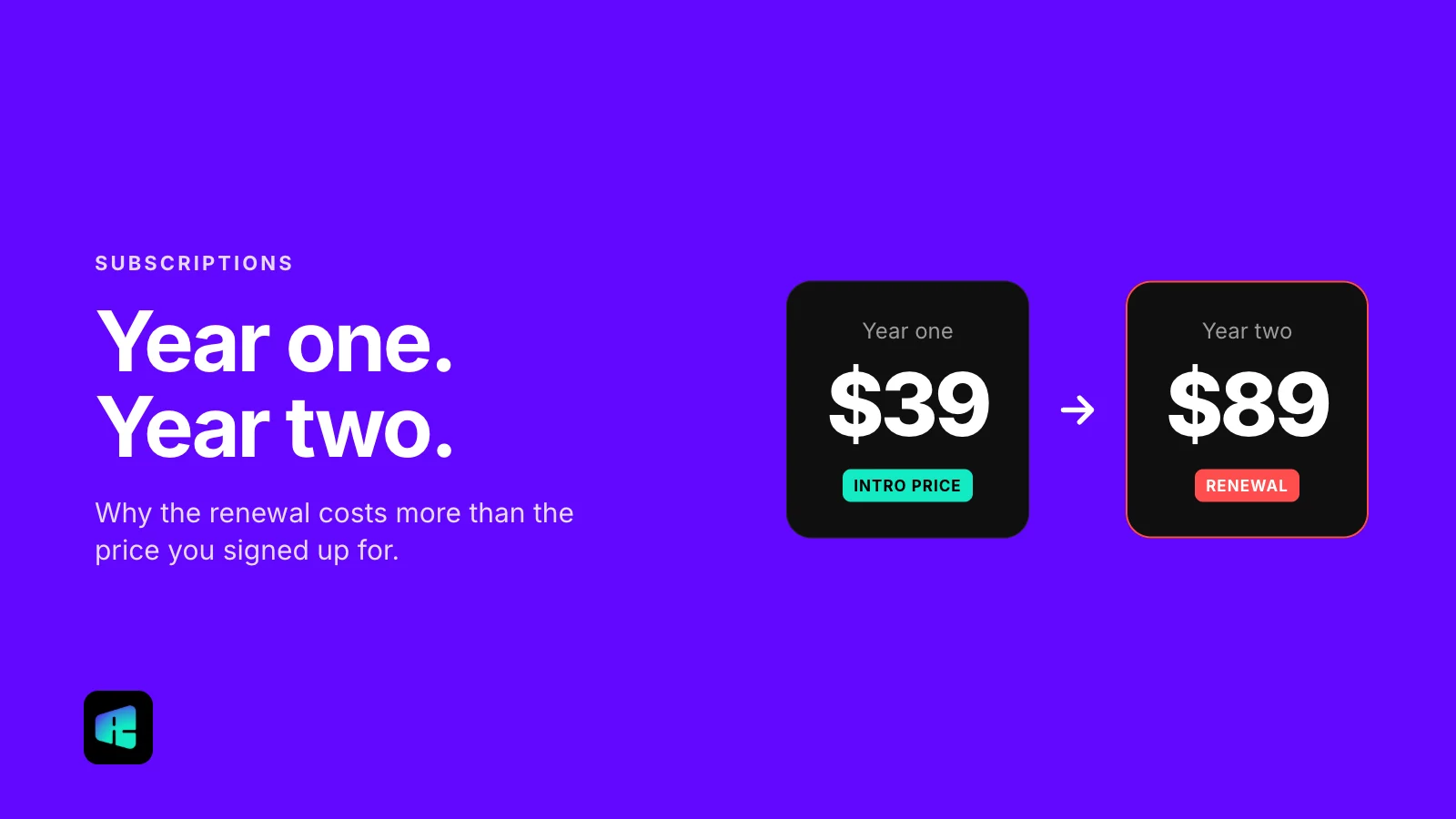
Introductory pricing makes the first term cheap and the renewal expensive. The real price is written down somewhere, and you still have options if the bill already arrived.

The short version
- Many subscriptions discount the first term and renew at a much higher regular rate.
- The renewal price is usually in the checkout fine print or the subscription terms, so find it before you pay.
- After a surprise renewal, check the refund window, ask for a lower rate, or cancel and request a refund.
A year ago you paid a low price for a service. This morning the renewal email arrived, and the number is roughly double. The service is the same as before. The discount ended, exactly as the terms said it would.
How introductory pricing works
Many subscriptions are sold with two prices. The first term, often a month, a year or two years, is discounted to get you to sign up. After that, the plan renews at what the company calls the “regular” rate, which is the price it expects to collect for as long as you stay.
Getting you to sign up is the hardest part for the company, and once you’re set up, switching takes effort. So it can afford to lose money on the first term if enough customers renew at full price without checking.
Where you see it most
The pattern is common wherever people rarely switch once they’re set up: VPNs, antivirus and security suites, web hosting and domains, meal kits, and streaming or TV bundles. Long first terms make the jump bigger and harder to notice. With a two-year deal, the renewal comes so late that few people remember what the full price was.
Where the renewal price is written
The renewal price is almost always disclosed somewhere, though rarely next to the large advertised number. Look in these places before you pay:
- The fine print under the price on the checkout page, often a line starting with “renews at” or “then.”
- The asterisk or footnote next to the advertised price on the pricing page.
- The terms of service or subscription terms, usually in a section about billing, renewal or price changes.
- The order confirmation email, which often states the next charge date and amount.
If the page shows a monthly figure for a yearly or two-year plan, find the total you’ll actually be charged today, then the total for the next term. If you can’t find the second number, ask support in writing before buying, and keep their answer as proof.
What to do after a surprise renewal
If the higher charge already went through, work through these steps in order.
- Check the refund window. Many services offer a money-back period, and some apply it to renewals as well as first purchases. Look up the exact number of days in the terms, because the period usually counts from the charge date.
- Ask for the introductory rate. Contact support and say plainly that the renewal price is more than you’re willing to pay. Some companies have a discounted offer they only give to customers who ask.
- Cancel and request a refund. If they won’t lower the price and you’re still inside the window, cancel and ask for the renewal charge back. Keep the confirmation.
- Turn off auto-renewal either way. If you decide to stay at the new price, switch auto-renewal off and set a calendar reminder, so next year you choose whether to renew instead of being charged automatically.
If you bought through Apple or Google Play, the refund request goes to the store rather than the company. Apple handles these at reportaproblem.apple.com. On Google Play, open your order history and choose Report a problem next to the charge; if more than 48 hours have passed since the purchase, Google usually sends you to the app’s developer (see Google’s refund page).
A habit for the next purchase
Before you enter a card number for any subscription, write down two figures: what you pay today and what you pay at renewal. If you would happily pay the second number, the lower first price is a bonus. If you wouldn’t, expect to cancel or overpay when the first term ends.
For what it’s worth, RealityVPN costs $11.99 a month, and that’s also the renewal price. It’s written into our subscription terms, and you can read the details on the pricing page.