The sound of getting online: a eulogy for dial-up
AOL switched off its dial-up service in 2025. What that famous screech actually was, and what changed when the internet went quiet.

The short version
- AOL ended its dial-up internet service on September 30, 2025.
- Census data showed about 163,000 US households still relied on dial-up alone in 2023.
- The famous screech was two modems switching off the network’s echo control, agreeing on a standard and testing the line before sending data.
- A 56k modem never really hit 56k: in the US it was capped at about 53k, and line noise usually took more.
On September 30, 2025, AOL turned off its dial-up internet service. The company had announced it in August in a short support note, along with the retirement of the AOL Dialer software and the AOL Shield browser, both made for older operating systems and dial-up lines. The Associated Press covered it as the end of an era. It was, even if most of us had left that era twenty years earlier.
Not everyone had left. According to Census Bureau data cited by the AP, 163,401 US households were still using dial-up alone to get online in 2023, a little over 0.13% of homes with an internet subscription. So somewhere, right up to the last day, a modem was still singing.
What the screech actually was
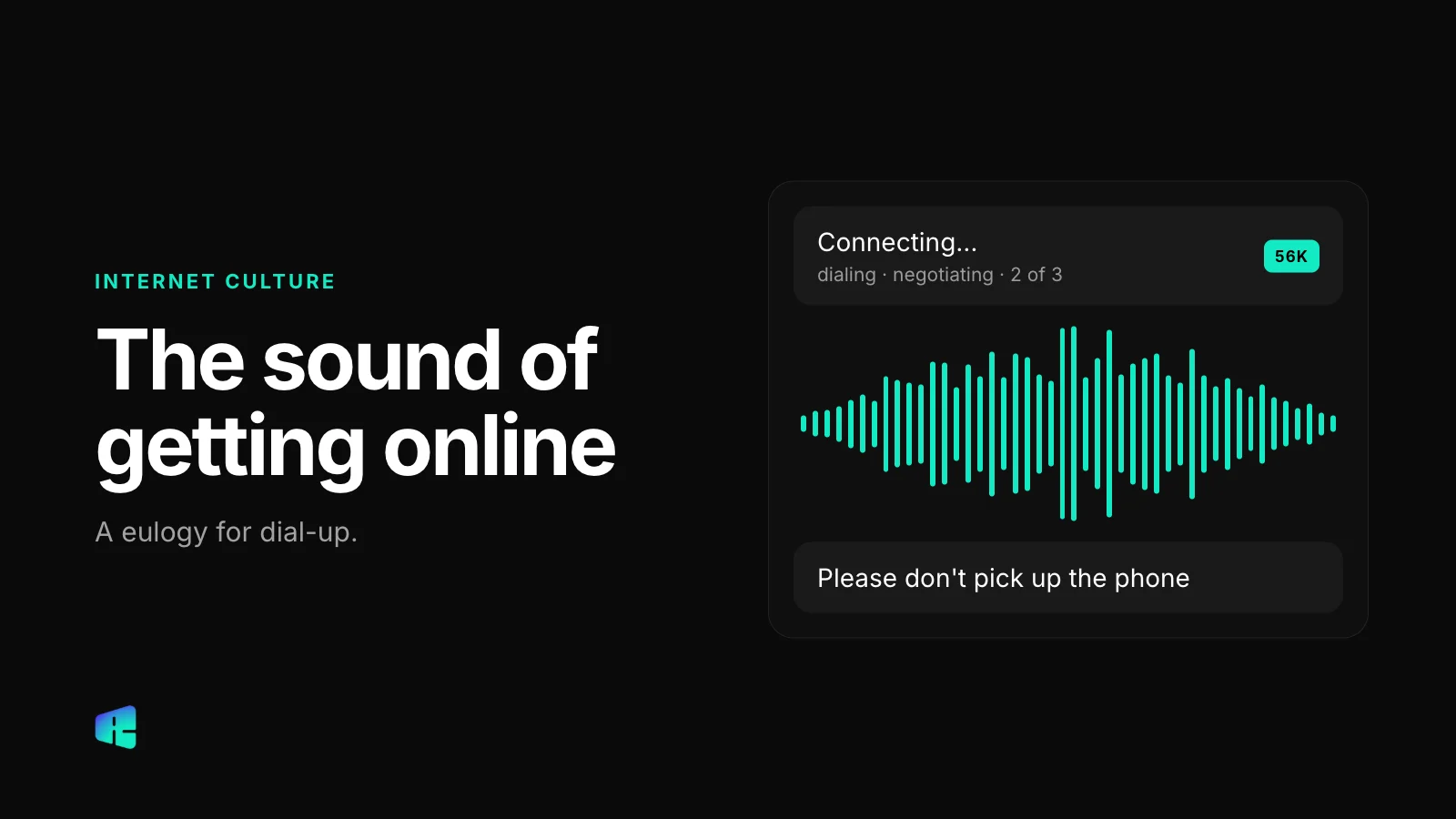
The noise everyone remembers was two machines meeting for the first time and working out how to talk. Your modem could hear the phone line, and so could you, because the modem’s speaker stayed on until the negotiation finished. Nobody designed it as a soundtrack. The likely reason it was audible is practical: if you dialed a wrong number and a person picked up, you’d hear them and could pick up the phone yourself.
The sequence went roughly like this:
- Dial tone, then the dialing. The modem picked up the line and punched in the access number with the same touch tones a phone uses.
- The answer tone. The modem at the provider’s end picked up and sent a steady, high tone. The tone told the phone network to switch off its echo suppressors, and small flips in it switched off the echo cancellers. Both help voice calls but would scramble data.
- The menu exchange. A quick back-and-forth of chirps where both modems listed the standards they supported and agreed on the fastest one they had in common.
- Line probing. Bursts of test tones sent down the wire to measure how much noise and distortion the line had, so the modems could adjust to it.
- The hiss. A wash of white noise as the modems trained on each other and started sending scrambled data. Then the speaker clicked off, and you were online.
Every connection was fitted to that particular call. A crackly line on a rainy day gave you a slower connection than a clean one at midnight, and the modem reported the number it settled on, the way a radio announcer reads out the temperature.
56k on the box, less on the line
The box said 56k. The connection almost never did. The 56 kbps figure was a theoretical download ceiling, and in the US, FCC limits on signal power over phone lines capped it at about 53 kbps before anything else went wrong. Uploads topped out at 33.6 kbps on V.90; the later V.92 standard allowed up to 48 kbps. Most people saw something in the 40s and learned to be grateful for it.
At those speeds, a single MP3 could take ten or twenty minutes on a good night. An album was something you started before bed and checked in the morning, hoping it had finished, hoping it was the right album, and hoping it wasn’t a recording of someone’s cousin playing the right album.
The phone in the kitchen
Dial-up used the household phone line, so nobody could use the internet and the telephone at the same time. Every family had to negotiate this. You were online, the download was at 87%, and someone in the kitchen picked up the phone to call the dentist.
They heard a burst of static. You saw a dialog box saying the connection had been lost. Both of you yelled at the same moment, from different rooms. Some households got a second phone line just to end this argument. Others split the evening into internet hours and phone hours, like divorced parents sharing a weekend schedule.
It also meant nobody could call you while you were online. Anyone who tried got a busy signal, which in the 1990s was the closest thing to a status that said “online now.”
CDs in the mailbox
AOL found new customers by sending them the software on a disc, over and over, whether or not they had asked. The CDs arrived in the mail and tucked into magazines, each offering some number of free hours, and the number kept going up. People used them as coasters, hung them in the garden to scare off birds, and in a few cases used them to install AOL.
When it worked, a cheerful recorded voice announced “You’ve got mail.” In 1998 the phrase became the title of a movie with Tom Hanks and Meg Ryan. For a few years that voice was the most reliable source of good news in many American homes.
When the internet went quiet
Broadband made the internet faster, and it also made it silent and always there. There was no dialing, no handshake, no moment where you decided to go online and then waited to be let in. Going online stopped being an event, and the connection became something the house simply had, like electricity.
That’s mostly a good trade. Nobody misses losing a download to the dentist. But the screech did one useful thing: it marked a doorway. You heard yourself going in, and when you hung up, you were out. Now the door makes no sound, and most of us never really leave the room.