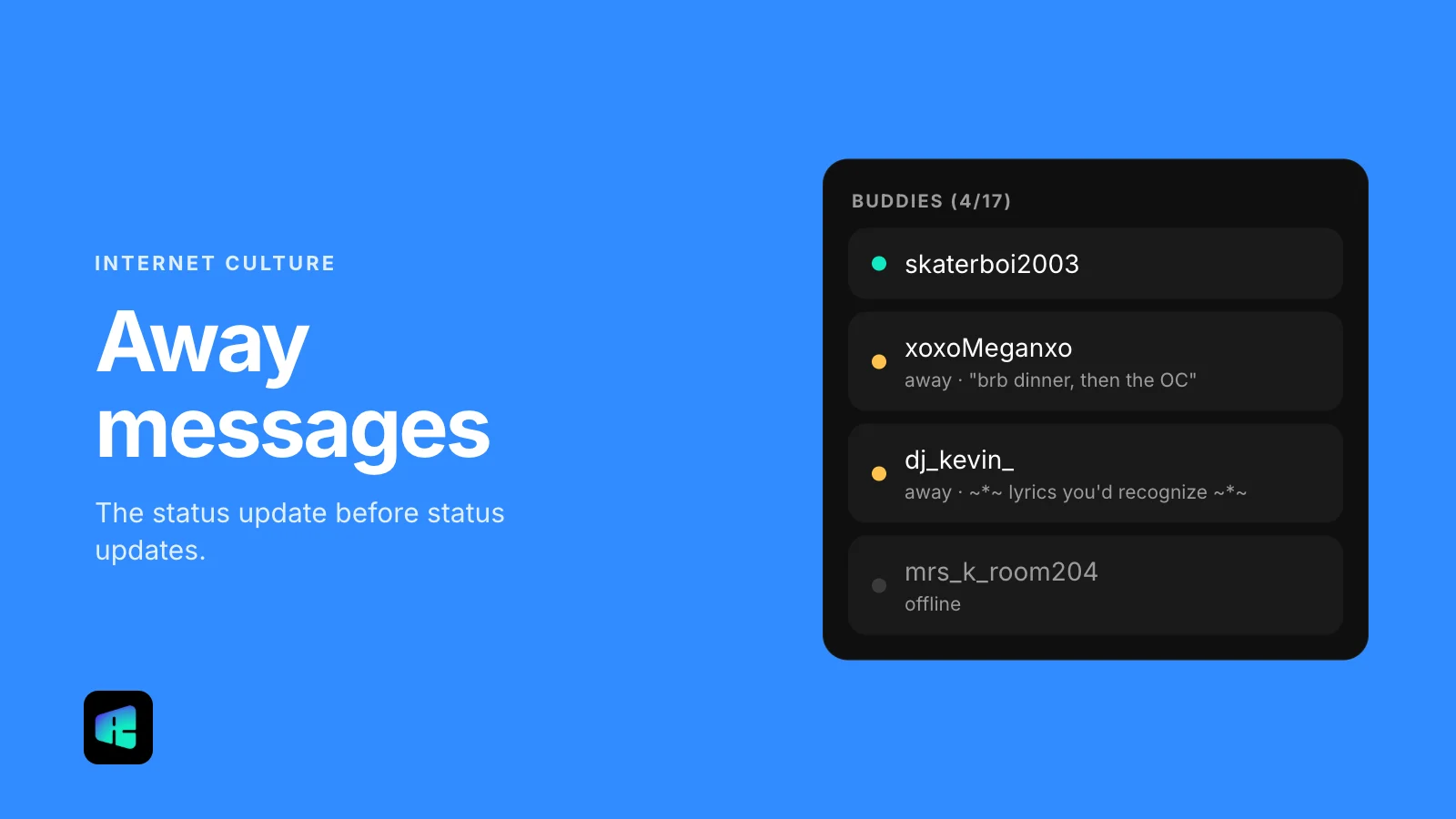
Away messages: the status update before status updates
Before “last seen” and read receipts, AOL Instant Messenger let you leave a note on the door. A short history of the away message.

The short version
- AOL Instant Messenger launched in 1997 and shut down on December 15, 2017.
- Away messages were an early, widely used way to tell everyone you knew where you were, or to post a song lyric instead.
- Statuses, “last seen,” typing indicators and read receipts carry the same idea, but they’re mostly generated automatically.
- On AIM, offline was the default; today being reachable is.
Somewhere around 2003, a teenager gets up from the family computer to go to dinner. Before she leaves, she spends eleven minutes choosing the right song lyric to post as her away message. It has to be sad, but not so sad that her mom asks about it, and it has to be about one specific person without naming them. Dinner can wait.
That was AOL Instant Messenger, or AIM. It launched in 1997 and shut down on December 15, 2017, after its owner said the way people communicate had changed. Global News reported the closing at the time. Buddy lists could not be exported, and the data was deleted after the shutdown.
A note on the door
For many people, the away message was the first way to announce their presence, or their absence, to everyone they knew at once. You set it and walked away, and anyone who messaged you got an automatic reply.
In theory it said where you were: “At practice, back at 6.” In practice it became a tiny public stage. People posted inside jokes, countdowns to summer, quotes from movies they had seen once, and a great many song lyrics, often with the band name in small letters underneath to prove they knew the band.
Some people set an away message while sitting right at the computer, so they could read incoming messages and choose whom to answer. Nobody admitted to it, and almost everybody did it.
The buddy list and the door sounds
The buddy list was a column of screen names, sorted into groups. AIM started you off with Buddies, Family and Co-Workers, and you could rename them or add your own, which is how many lists ended up with a group with a cryptic name that held exactly one person. The list also showed who had gone idle and who had posted an away message.
When a friend signed on, AIM played the sound of a door creaking open. When they signed off, a door slammed shut. Those two sounds carried a surprising amount of feeling. A door opening at 10:40 on a school night could make your evening. A door closing two seconds after you sent a message could ruin it.
Screen names and profiles
Screen names were picked at 13 and kept far longer than they should have been. A typical one combined a favorite sport, a birth year, a misspelled word, and a row of x’s or underscores because the good version was taken. Many people later had to put one of these on a college application or a first résumé, and quietly made a new account.
Then there was the profile: a small text box where you could put whatever you wanted the world to know. Mostly that meant quotes, a list of best friends’ initials and the occasional mysterious line meant for one reader. It was a personal website the size of an index card, and people put real care into it.
Where the away message went
The idea survived, and software took over the job of writing it. Facebook status updates took the away message and made it permanent. Messaging apps now show when someone was last seen, whether they’re typing, and whether they’ve read what you sent. Slack shows a green dot.
An away message was something you wrote yourself, on purpose, when you chose to. Most presence signals today are generated for you, and turning them off usually means digging through privacy settings, if the app allows it at all.
On AIM, being offline was the normal state. You signed on after school or after dinner, signed off before bed, and your screen name sat in the Offline group at the bottom of everyone’s buddy list until the next evening.